Watch Absolar's  ✨ 2025 Performance Wrap ✨
Watch Now

Solar Wrap 2025

Data Insights Behind Each Analysis

Receive a straightforward solar feasibility report for your building or portfolio, showing cost estimates, financial savings, and finance options. No jargon, just clear insights to help you decide if solar is the right step for your business.


Absolar's solar wrap for 2025
Carbon emissions reduction by switching to solar PV

How Solar PV Systems Reduce CO₂ Emissions

Your Solar Annual Wrap includes an estimate of how much CO₂ emissions your system has helped avoid.

This is based on a simple principle: every kilowatt-hour generated by your solar panels is electricity that does not need to be produced by the national grid, which includes the burning of fossil fuels.

To calculate this, we follow these steps:

  1. Measure your actual solar generation
    We use your recorded kilowatt-hours (kWh) over the year. This is the clean energy your system produced on site.
  2. Apply the official UK grid emissions factor
    Each kWh of grid electricity has an associated carbon intensity. We use the latest government-published emissions factors for electricity. These factors reflect how much CO₂ the average grid-supplied kWh would have produced.
  3. Calculate avoided emissions
    Solar generation (kWh) × grid emissions factor (kg CO₂/kWh) gives the total kilograms of CO₂ avoided.

We convert this into tonnes of CO₂ to match standard reporting formats.

Data source: Official UK Grid emissions factors

How we visualise your energy production

How Many Cups of Tea Your Solar Energy Could Make

To make the environmental impact more relatable, your Solar Annual Wrap includes a fun comparison: how many cups of tea your solar energy could have brewed over the year.

This is based on the typical amount of electricity needed to boil water in a standard kettle.

Here’s how we calculate it:

  1. Start with your annual solar generation
    We take the total kilowatt-hours (kWh) your system produced during the year.
  2. Use a standard energy-per-boil assumption
    We used the following assumptions:
    • One cup = 300 mL of water (0.3 kg)
    • Temperature rise ≈ 15 °C → 100 °C = 85 °C
    • Specific heat of water = 4186 J/kg·°C
    • 1 kWh = 3,600,000 J
    • This would give a theoretic energy demand for brewing at 29.6 Wh per cup
  3. Considering real-world efficiency loss
    In practice, boiling water often requires more energy. Kettles have varying efficiency, people may fill larger cups, and winter room temperatures can be lower than 15 °C. These factors mean the actual energy requirement is typically higher than the theoretical minimum.
  4. Estimate number of cups
    Total solar Wh ÷ 45 Wh gives the approximate number of cups of tea your solar energy could heat.

This gives a more physics-based, accurate estimate while keeping the comparison fun, simple and relatable for clients.
How UK grid has become cleaner

How the UK Grid Has Become Cleaner Since 2020

When calculating your CO₂ emissions reduction, we reference the official UK grid carbon intensity published in government statistics.

This value represents how much carbon is emitted, on average, for every kilowatt-hour (kWh) of electricity supplied by the national grid.

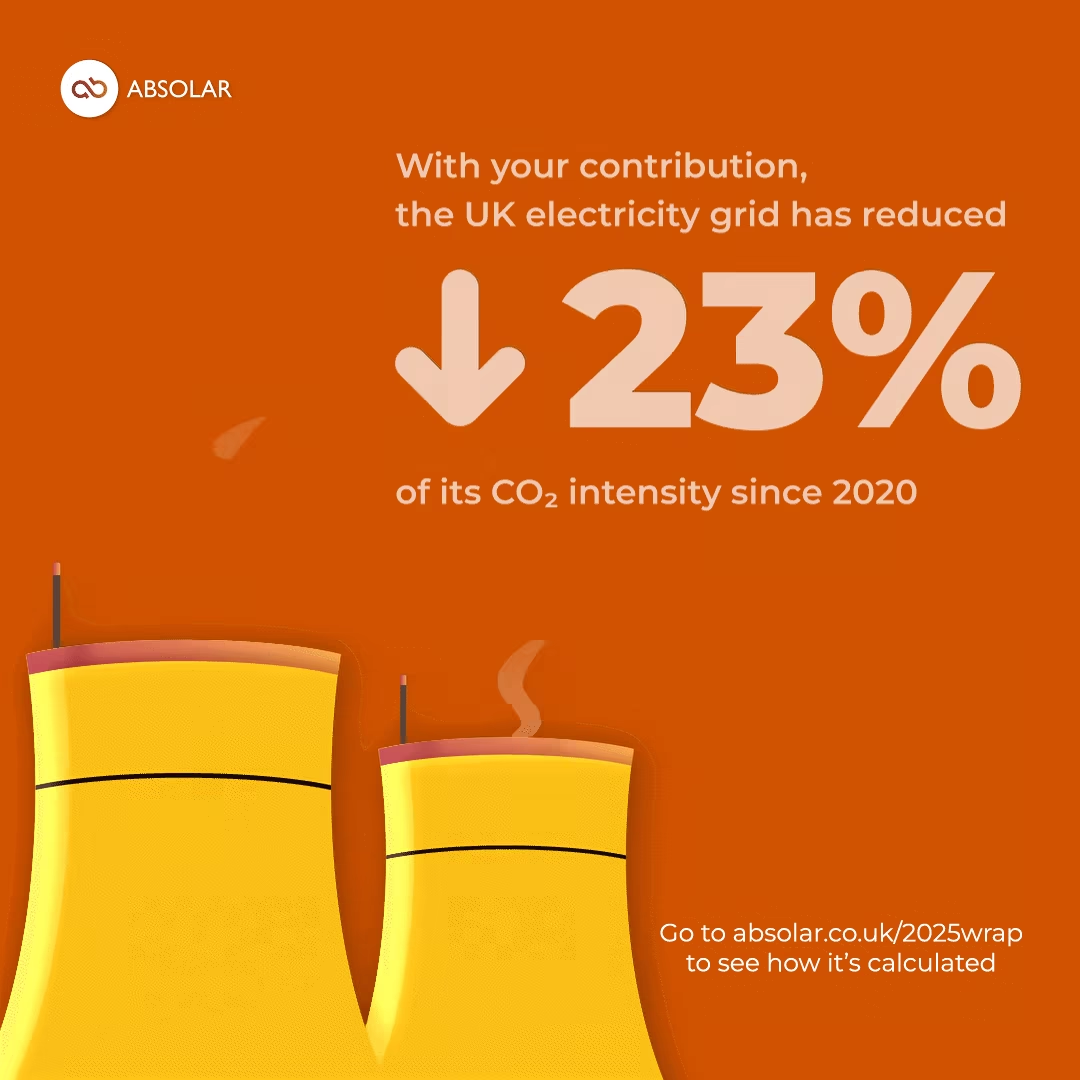
The UK grid has become continuously cleaner in recent years.

  1. In 2020 The grid carbon intensity was 0.25091 kg CO₂ per kWh.
  2. By 2025 This value has fallen to 0.19323 kg CO₂ per kWh.

This is a reduction of around 23% in carbon intensity.

The change reflects the ongoing decarbonisation of the national electricity system due to increased renewable generation, improved grid efficiency and reduced reliance on coal and gas.

Data source: Official UK Grid emissions factors
How Absolar monitor solar production

How We Identify Your PV's Most Productive Day and Week

This helps you see when conditions were most favourable for solar generation and gives you a quick sense of your system’s peak output.

Here’s how we calculate it:

  1. Gather your generation data ever 15 minutes
    We begin by collecting your recorded solar generation and grouping into daily totals. This tells us how many kilowatt-hours (kWh) your system produced each day.
  2. Data Cleansing
    Raw data often contains gaps or irregularities caused by internet dropouts, temporary system faults or communication issues. We run automated checks to detect missing intervals, remove noises, and correct invalid readings.
  3. Identify the highest-production day and week
    Once the dataset is validated, we calculate the total energy generated each day and each calendar week.
    • The day with the highest total becomes your Most Productive Day
    • The week with the highest combined generation becomes your Most Productive Week

Absolar's Solar Performance Wrap - 2025

Thinking about solar?
We'll show you what's possible
Get a survey
Something on your mind?
Reach out to us
Contact us