

The UK Science Park Association (UKSPA) SPRING Conference, held at Technology & Innovation Centre, University of Strathclyde, brought together leaders from science parks, universities, technology companies and investors to discuss the evolving role of innovation campuses across the UK. It was a valuable opportunity to exchange ideas on how science parks can accelerate research, support high growth businesses, and address emerging challenges such as energy infrastructure and artificial intelligence.
For Absolar, the discussions strongly reinforced the direction we have been taking: combining engineering, data and long term energy planning to support innovation campuses.
A recurring theme throughout the conference was the unique role science parks play in bridging the gap between early stage research and market adoption.

Many breakthrough technologies originate in universities and research institutions, yet the path to commercialisation often requires specialised facilities, collaboration networks and patient investment.
Science parks provide this environment, which brings together research groups, startups, scale ups and established technology companies in one ecosystem.
This concentration of expertise allows ideas to move faster from laboratory to real world deployment.
For companies like Absolar, working with science parks offers a unique opportunity to support organisations that are actively shaping the technologies of the future.
Another key discussion centred on energy infrastructure.
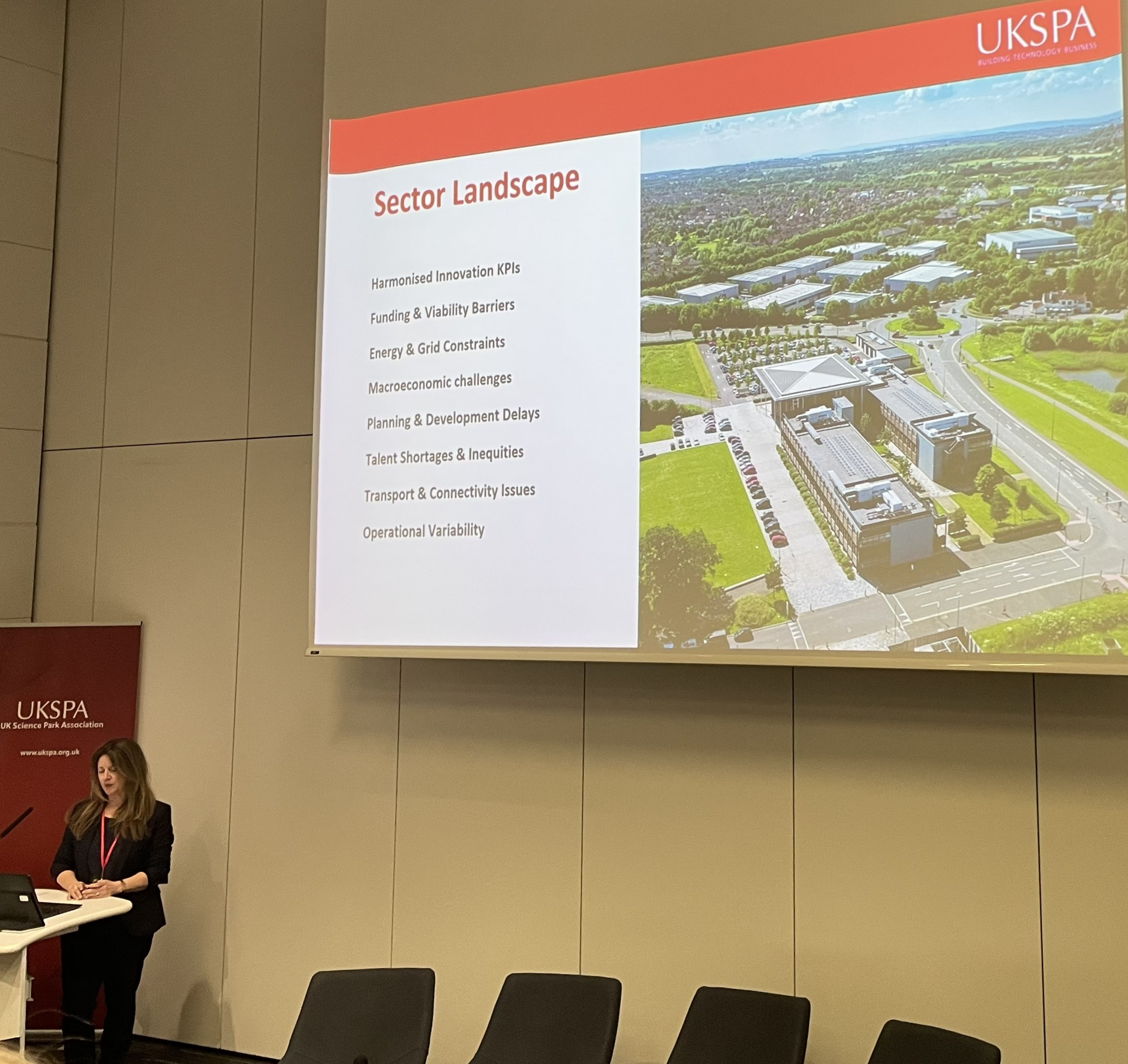
As outlined in UKSPA’s strategic priorities, energy supply and grid capacity are emerging as major constraints for innovation campuses and advanced manufacturing facilities.
Many science parks are expanding rapidly, attracting energy intensive sectors such as data science, life sciences, advanced materials and space technology.
At the same time, grid connections across the UK are becoming increasingly constrained, which is a challenge that aligns closely with Absolar’s work.
By combining solar engineering, remote survey technology and performance monitoring, our goal is to help campuses unlock on site renewable generation and manage energy more strategically across their estates.
For science parks, energy and energy systems are becoming a strategic infrastructure decision.
The topic of Artificial intelligence has been heavily discussed during the conference, with explorations on both the opportunities and the risks associated with the rapid expansion of AI technologies.
On one hand, AI is enabling new scientific breakthroughs, accelerating data analysis and unlocking new forms of automation.
Many science park tenants are directly involved in developing or applying these technologies.
On the other hand, AI infrastructure can be energy intensive, as data centres, large scale computing and machine learning workloads require significant power.
This raises important questions about energy efficiency, infrastructure planning and sustainability.
The intersection between digital innovation and energy infrastructure is therefore becoming increasingly important for science parks.

A particularly thoughtful debate focused on the environmental and ethical considerations surrounding solar panel manufacturing.
While solar energy is widely recognised as a critical technology for decarbonisation, the industry must also ensure responsible supply chains and transparent manufacturing practices.
Topics such as material sourcing, manufacturing emissions and labour standards are becoming more prominent in project discussions.
For organisations investing in renewable energy, the conversation is shifting from simple deployment to responsible deployment.
Ensuring solar projects are both environmentally and ethically sound will be an important part of maintaining long term trust in the sector.
One of the most interesting aspects of the conference was seeing how different science parks specialise in different sectors.
Some focus heavily on health and life sciences, hosting laboratories, clinical research facilities and biotech companies; others are hubs for satellite technology and space applications; some concentrate on agricultural technology or environmental science.
These sector differences lead to very different building designs, operational requirements and energy demand patterns.
Laboratories, data facilities, advanced manufacturing units and office spaces all have distinct energy profiles.
This reinforces a point we often make when designing solar projects: there is no universal template.
Solar energy systems for innovation campuses need to be designed around the specific characteristics of each site, building and tenant mix.
Tailored infrastructure is essential for achieving long term performance.
Perhaps the most valuable outcome of the UKSPA Sprint Conference was the opportunity for open conversation across the science park community.
Operators, researchers, technology companies and infrastructure providers were all part of the discussion.
This type of collaboration is essential for addressing complex challenges such as energy supply, sustainability and digital transformation.
A key takeaway from this conference is that science parks are not simply collections of buildings - they are ecosystems where innovation, infrastructure and community intersect.
For Absolar, the conference reinforced the importance of working closely with science parks as long term partners.
As campuses grow and technologies evolve, energy infrastructure will play an increasingly strategic role in enabling innovation.
Solar generation, energy monitoring and data driven planning can help science parks manage this transition while maintaining their focus on supporting breakthrough research and high growth businesses.
The conversations at the UKSPA SPRINT Conference highlighted both the opportunities and the responsibilities that come with building the innovation campuses of the future.



© 2026 Absolar Solutions Limited

.avif)
.avif)