

On Wednesday 12 August, Southampton experienced the deepest partial solar eclipse the UK has seen since 1999. Between 6:16pm and 8:37pm, the Moon crossed in front of the Sun, reaching 92% coverage at its peak around 7:15pm. The next event on this scale will arrive in 2090.
We study the sun's movement every day, as a job and an obsession. An event of this size, low in the western sky and in full view of our Southampton rooftop, gave us reason to treat the evening as a working opportunity rather than a passing show.
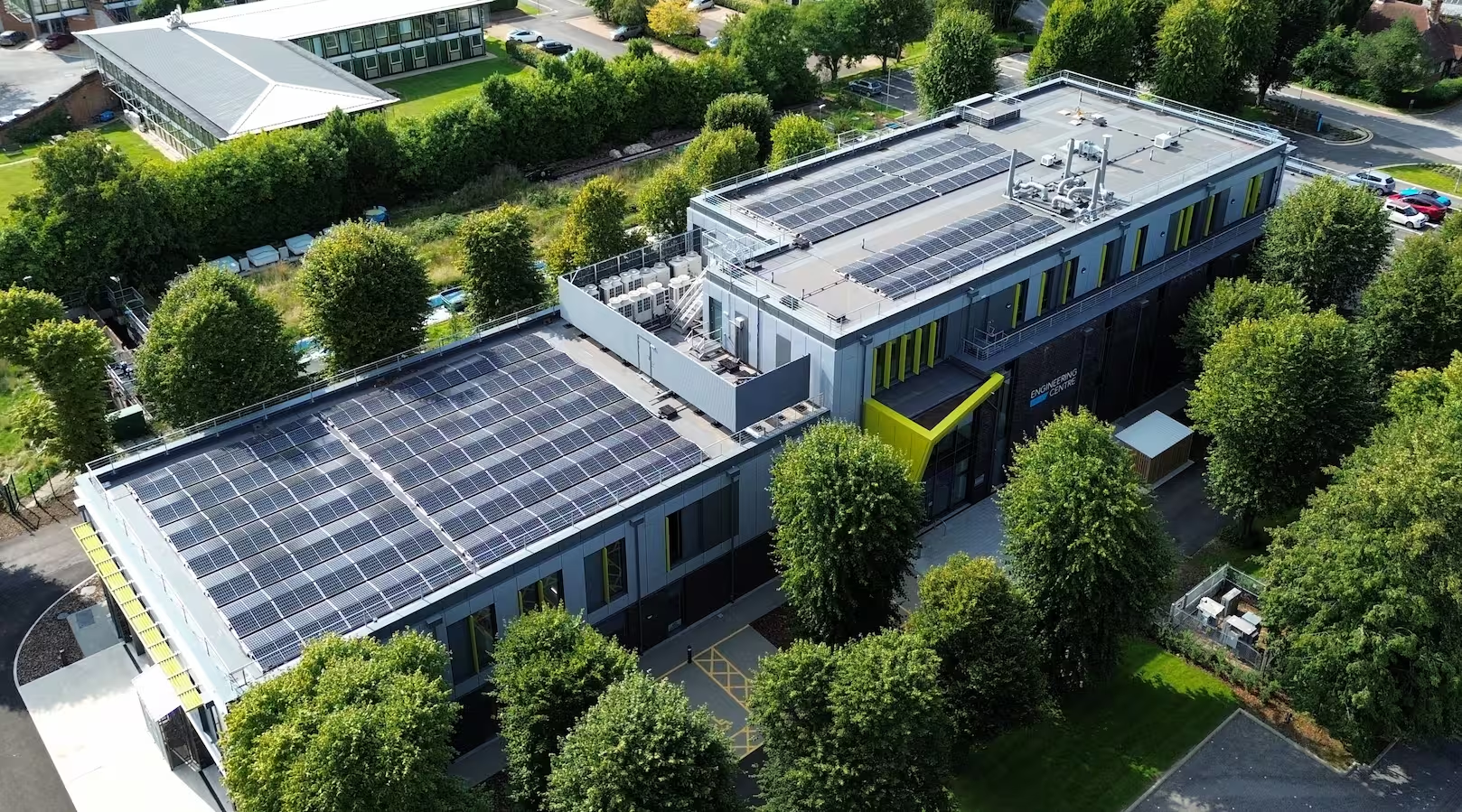
The Absolar team installed irradiance metering and time-lapse cameras on the rooftop of the Engineering Centre at Southampton Science Park, home to a 101.08 kWp solar PV system Absolar installed and continues to manage. Full details of the project are covered in our case study.
.avif)
Conditions were ideal: a cloudless evening produced a clean, predictable clear-sky generation curve ahead of the eclipse, giving us a strong baseline for comparison.
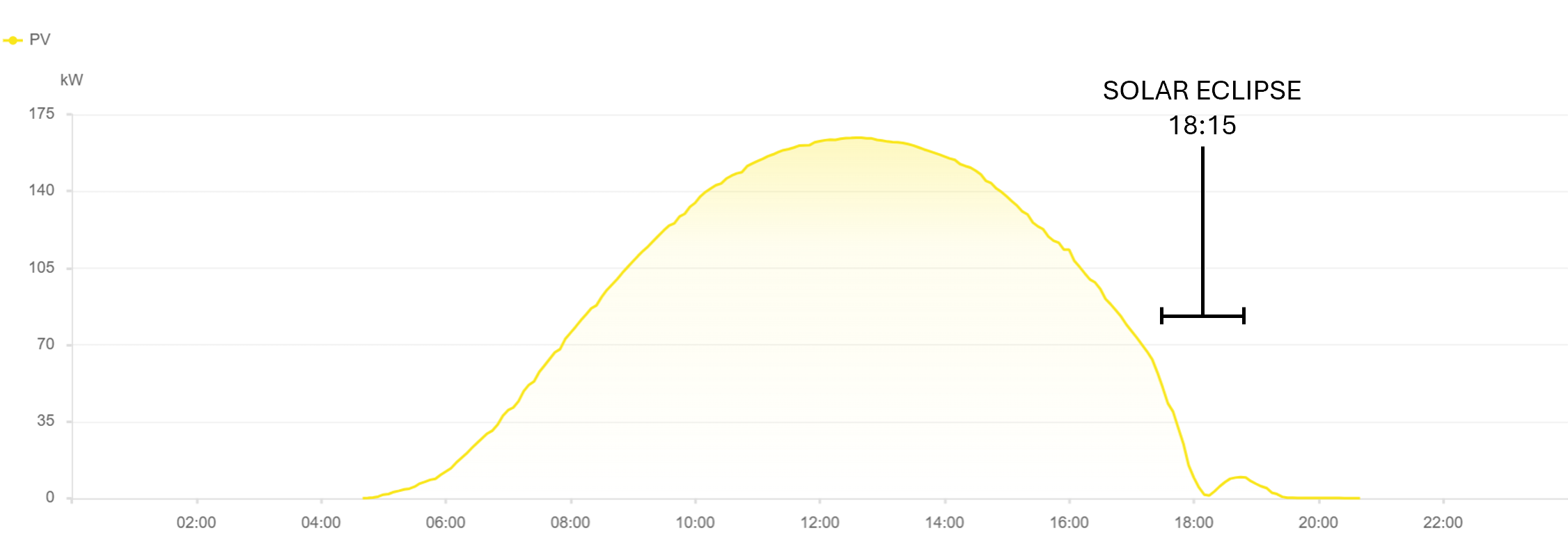
Generation tracked the eclipse closely, falling as coverage increased toward the 7:15pm peak and recovering as the Moon moved clear of the Sun.
We tell clients what their system will produce. Wednesday gave us a chance to prove it under some of the most extreme conditions we'll ever see. On Wednesday, a 92% drop in sunlight showed up in our data exactly where the physics predicted it would, and the recovery showed up just as precisely. That level of precision is available on every site we monitor, every single day.
Dr Phil Wu, Director, Absolar
Numbers like these show that solar performance can be measured moment to moment, under real conditions, using real data. Wednesday gave that principle an unusually sharp demonstration.
We have been monitoring solar PV output at the Engineering Centre, and across every site we manage, since installation.
Irradiance meters, generation monitoring, and the rest of our monitoring setup run continuously, on ordinary days as much as rare ones. Wednesday simply gave that ongoing work a distinctive data point to point to.
A selection of images from the evening are below, including the eclipse itself, the generation curve, and the team on site.
.avif)
If you're unsure whether solar will work for your site, a data-led assessment remains the best place to start.
If you would like to know more about your building's solar potential, you can request a free Remote Solar Survey here, or contact our friendly solar engineering team.
📍 Visit us: Engineering Centre, Southampton Science Park, Southampton, SO16 7PT
📞 Phone: 02382 680 106
✉️ Email: info@absolar.co.uk
🌐 Website: www.absolar.co.uk
👉 Or use our AI-powered solar calculator to request a Remote Solar Survey report for your property.
Follow us for updates: LinkedIn


© 2026 Absolar Solutions Limited

.avif)