
Since the start of 2026, the UK has seen exceptionally persistent rainfall, with rain falling on many days right through January and early February [source: MET].
In parts of southern England, including Cornwall, January brought record-breaking rainfall totals, and some regions have experienced rain on every day so far this year according to weather reports [source: BBC].
Given this context, it’s natural for solar asset owners and operators to ask how a very wet, persistently cloudy month impacts the performance of a commercial solar PV system.
To move beyond assumptions, we analysed real monitoring data from a commercial solar PV system, comparing its power output in January 2025 with that in January 2026.
As the system, layout, and operating conditions remained unchanged, the difference was the weather.

That represents a reduction of around 7%.
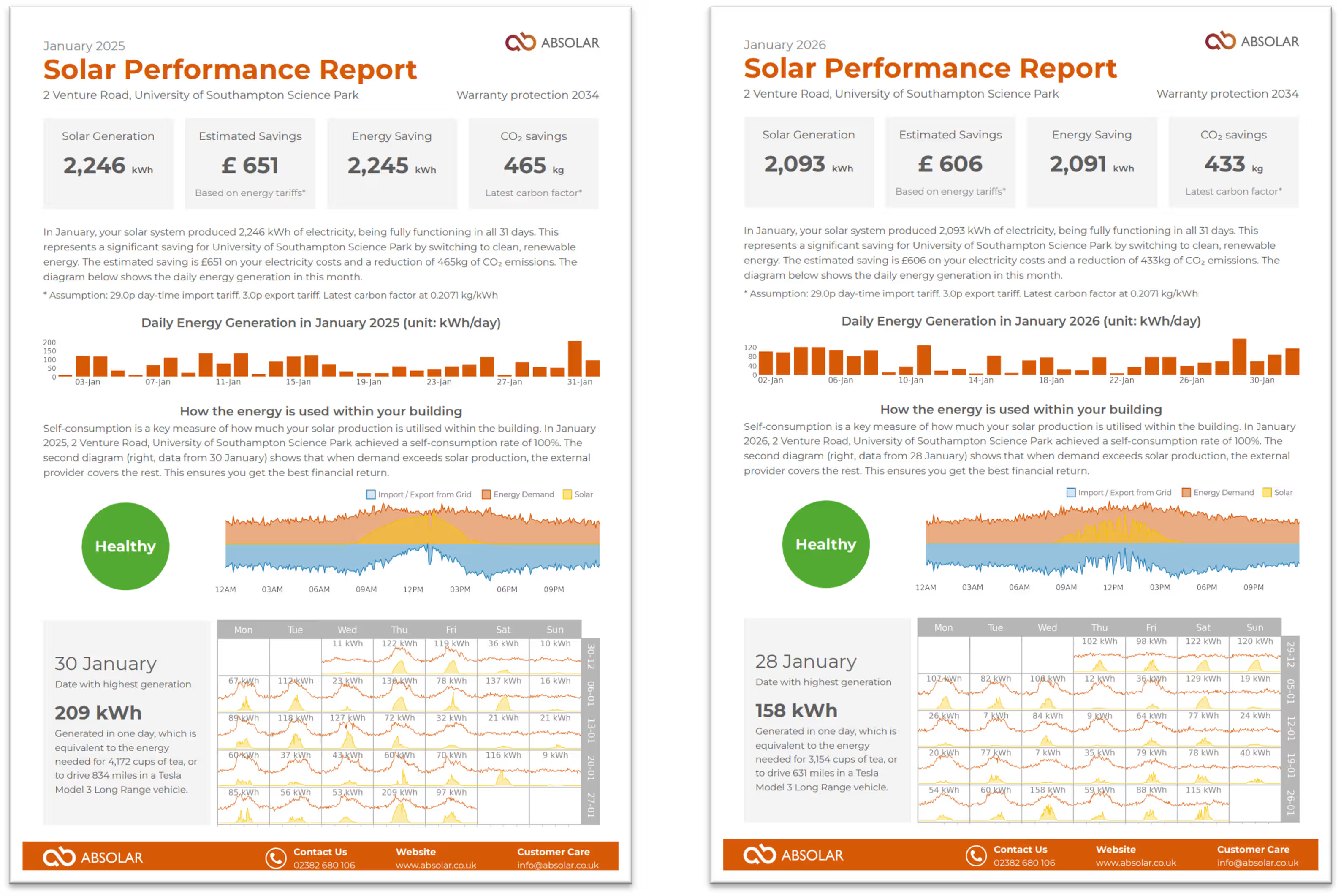
The analysis is based on data taken from Absolar’s monthly performance report, which summarises how each system performs over a full calendar month.
These reports are generated automatically from live monitoring data and issued to clients as standard, providing a consistent, like-for-like view of performance over time.
The diagram below provides a direct comparison of daily energy production in January 2025 and January 2026.
.avif)
This reduction is caused primarily by weather conditions, as sustained cloud cover suppresses peak generation by reducing the intensity of direct sunlight.
In January 2025, the highest-producing day reached 209 kWh. In January 2026, the best day reached 158 kWh. This means on the day with highest energy generation, the production is 24% lower in 2026.
.avif)
Solar panels generate electricity from daylight, and therefore the lack of irradiance impacts directly on the power generation from solar PV panels.
However, overcast conditions do not switch systems off entirely, and that's why you could see see a small amount of energy production every day.
In this case, we have found that a very wet January reduced monthly generation by 7%, when compared to the same period last year.
Whilst the weather headlines tend to focus on extremes: the wettest week, the darkest day, the stormiest month; the solar performance, however, should be assessed over longer periods.
Well-designed systems are modelled using long-term weather data and conservative assumptions, which is to address the principle - what setup could provide energy users the optimal return on investment, continuously over the next 20 - 30 years.
The systems are designed to perform through poor weeks and average months, not only during ideal conditions.
There is also a quieter benefit to regular rainfall - rain helps wash away dust, pollen, and airborne debris that can accumulate on panels during dry periods.
Over the course of a year, this natural cleaning can help maintain efficiency without manual intervention.

This comparison reinforces a key principle: solar should be treated as long-term infrastructure, not a fair-weather technology.
Day-to-day output will vary with conditions. Monthly performance will fluctuate. What matters is that systems are designed, installed, and monitored with enough rigour to deliver predictable performance over decades, not just during favourable seasons.
A wet start to the year may change the profile of generation, but it does not undermine the fundamentals of a well-engineered solar PV system.
Absolar’s team combines advanced remote surveying with meticulous project planning and stakeholder coordination - a critical factor in delivering safe, cost-effective installations at scale.
As this project progresses, we’ll continue to share updates and outcomes; and showcase how clean energy can work hand-in-hand with thoughtful design, safety, and long-term value for businesses and communities.
If you would like to know more about your building's solar potential, you can request a free Remote Solar Survey here, or contact our friendly solar engineering team.
📍 Visit us: Engineering Centre, Southampton Science Park, Southampton, SO16 7PT
📞 Phone: 02382 680 106
✉️ Email: info@absolar.co.uk
🌐 Website: www.absolar.co.uk
👉 Or use our AI-powered solar calculator to request a Remote Solar Survey report for your property.
Follow us for updates: LinkedIn


© 2026 Absolar Solutions Limited
.avif)
.avif)
